We understand that it can be tough growing up in this day and age, with so many competing demands and expectations on a young person’s time and energy. As such, we provide a comprehensive and holistic pastoral care system across all levels of the school, to give boys the tools to maintain their mental health and feel supported and known.
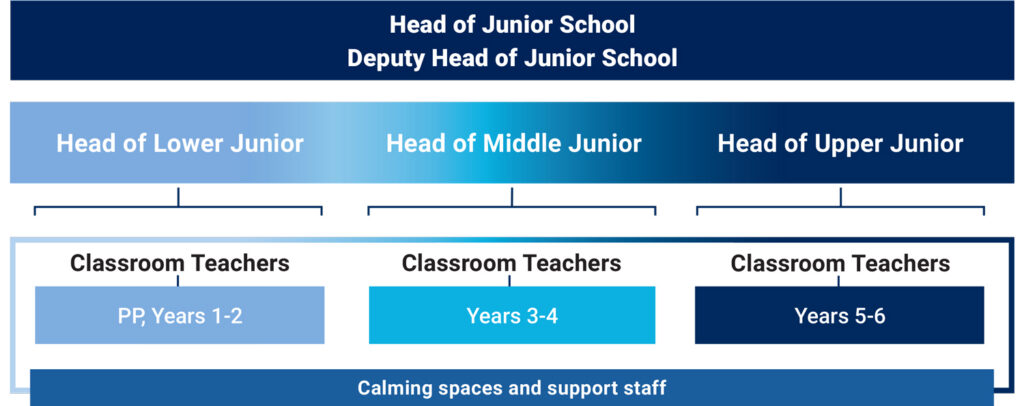
In the younger years, our class teachers are responsible for the day-to-day welfare of their students. They are supported by the School Chaplain, a School Psychologist, a dedicated Learning Support teacher, the Deputy Head of Junior School and the Head of Junior School.
Specialist wellbeing programs taught in the Junior School focus on social and emotional learning, safety, building relationships and learning protective strategies.
There is a calming, sensory space in the Lower Junior area – known as The Snug – for Pre-primary, Year 1 and Year 12 boys to use should they need to take a step away from the classroom for some quiet time. Similar spaces are being planned for the Middle and Upper Junior areas.
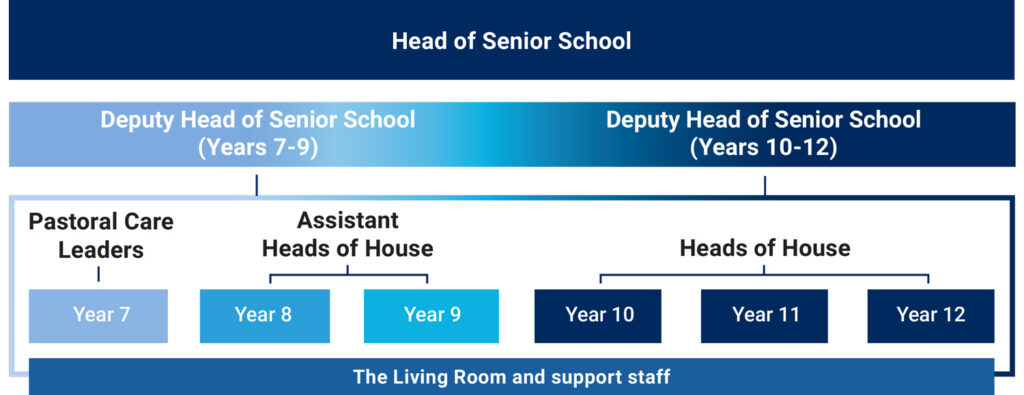
Each Year 7 class has its own Pastoral Care Leader (PCL), a teacher who is responsible for maintaining effective communication between students, parents and staff. Particular emphasis is given to boys entering the School for the first time and to boarding students. The PCLs are supported by the Head of Year 7 Student Engagement, Deputy Head of Senior School (Years 7-9), School Chaplain and School Psychologist.
The PCLs also teach the personal development program, which focuses on the principles of Positive Education. This philosophy rests on the premise that teaching skills promoting character strengths and virtues also promotes learning and academic success. We explore topics such as growth mindsets, gratitude, positive relationships, communication, mindfulness and connection.
The House system provides an extra layer of peer support. Boys across the Senior School are placed in House factions, where they develop positive relationships with boys across different year groups.
Boarding students in Brine House also take part in a separate personal development program, which relates to the needs of boys in boarding.
The House system provides the framework for day-to-day pastoral care in the Senior School. Each boy belongs to one of 10 houses, where they connect with boys across year groups. The Head of House and Assistant Head of House are responsible for the wellbeing of boys in their house and communicate with parents.
Two of these houses are boarding houses, with the house faction also being the name of the boarding house in which the boys live – either Faulkner or Wilson House. Boarders also take part in a separate personal development program, which relates to the needs of boys in boarding.
With Year 9 known to typically be a challenging year for adolescent boys, the Year 9 program focuses on character development, providing students with engaging learning experiences that help them to understand themselves, connect with others and build character.
All Senior School students are offered additional support from the School Chaplain, School Psychologist, School Social Worker, the Director of Students and Leadership, and Curriculum Support staff. They also have access to The Living Room (pictured above), a dedicated space in the Health Centre where students can take time out if they are feeling overwhelmed. Here they can access wellbeing resources and calming activities, and speak to our School Social Worker or Psychologist.
Student use of mobile phones and social media
At Hale School, we prioritise the wellbeing, academic focus, and healthy development of our students. In response to growing concerns about the impact of smartphones and social media on young people’s mental health, our school is taking a proactive stance. Starting in 2025, students in our Junior School and Year 7 will not be permitted to bring smartphones or smartwatches to school, nor should they have access to social media. This initiative aligns with research and community feedback emphasising the importance of a balanced and safe approach to technology use.
Our goal is to create an environment that supports face-to-face connections, encourages outdoor and physical activities, and fosters deep concentration and academic growth. For students who need a mobile device for safety, we recommend using a basic retro phone that does not access the internet or social media. Such a device would need to remain in the student’s locker or school bag, if brough on campus.
This policy is part of a broader strategy to address the challenges of our digital age, equipping students with the skills and resilience needed to navigate technology responsibly. It reflects the strong support of our parent community and our commitment to a collaborative approach between families and the school.
Here is an infographic summarising our new policy and below a section addressing frequently asked questions to help families transition smoothly. Together, we can ensure a healthier and more focused future for our students.
Why isn’t Hale School allowing Junior School and Year 7 and 8 students to use smartphones or smartwatches?
We understand that technology can play an important role in keeping families connected. However, research clearly highlights the negative impact of social media and smartphone addiction on young people. As a school, we are well positioned to collaborate with families to address this issue. Our aim is to foster a community that encourages responsible and appropriate use of technology while allowing students to learn, play and build positive, real-world relationships.
Will every student in these year groups truly not have a smartphone or smartwatch?
The success of this initiative relies on collective commitment. As a school, we prioritise students’ mental health and academic success over the ownership of these devices. As a parent, you have the opportunity to support this initiative and contribute to positive change for your son, his peers and the wider community. If we all stand together on this, then yes, every student will delay access to social media, smartphones and smartwatches until they are mature enough to engage safely and appropriately.
I’m worried this decision will upset my son. How can I convince him to support it?
It’s natural to feel anxious about this change, especially when it affects your son’s social connections. You can frame the conversation by emphasising that everyone in his year group will be in the same situation. Highlight the benefits of face-to-face interactions with friends, which foster healthier, more balanced and inclusive relationships.
What if he finds other ways to access social media?
We acknowledge that some students may attempt to access social media through other devices at home. As part of our digital citizenship education, we encourage families to maintain open discussions about responsible technology use and the importance of trust. Setting clear boundaries for device use, such as banning tablets and laptops in bedrooms, encouraging study in open areas, and establishing time limits for recreational use can help. Ultimately, fostering trust and open communication will help your son understand the importance of these boundaries for his wellbeing.
We promised our son an iPhone for Christmas or his birthday. How can we go back on that promise?
Making tough decisions often yields the greatest benefits. In this case, your son’s wellbeing is the invaluable outcome. Explain to him that this is a temporary measure to help him grow into using technology wisely. Reassure him that when the time is right, he will have the opportunity to use a smartphone responsibly alongside his peers.
What should we do if our child already has a smartphone or smartwatch?
If your son already has a smartphone or smartwatch, we ask that you take it off him and replace it with a non-smart (retro) phone to ensure a level playing field for all students. You could store the device for future use, trade it in at JB Hi-Fi (https://www.jbhifi.com.au/pages/jbtradein), or pass it on to an older family member or friend.
Can my son wear a smartwatch to school?
Smartwatches are not be permitted for Junior School or Year 7 or 8 students. While some parents choose smartwatches for tracking and communication, these devices often allow access to social media and calling features, which are not suitable for the classroom. We recommend swapping the smartwatch for a retro phone or a tracking-only watch. Alternatively, Apple AirTags paired with a simple watch can be a practical solution for parents focused on tracking.
Is my son allowed to bring a retro phone to school?
Yes, non-smart phones, such as the Kidscomm P110, can be brought to school. However, they must be turned off and remain in lockers or school bags during school hours. If you need to contact your son during the day, please reach out to the appropriate school administration office.
Can we lock down and manage our son’s existing smartphone or smartwatch?
We appreciate the commitment some families undertake to assist with responsible device usage. However, our aim is to create clear boundaries around devices that can make calls and access social media or the internet. ‘Managed’ devices will not be allowed.
What if my son uses his phone for medical purposes?
If your son has a medical condition that requires the use of a device, please contact the school’s Health Centre to discuss accommodations.
How will the School ensure compliance with this position?
Students will be regularly reminded of the rules, and staff will monitor compliance during the school day. Non-compliant devices found in use will be confiscated and returned to parents. We rely on families to support this initiative by ensuring their sons do not bring restricted devices to school.
What happens if my son feels excluded because he can’t access social media?
The School is committed to fostering an inclusive environment. By implementing this policy across the board, all students in Junior School and Years 7 and 8 will be in the same position. In addition, the School will promote activities, programs and discussions to strengthen in-person friendships and build resilience.
What measures are the School taking to educate students about responsible technology use?
We incorporates digital citizenship education into the curriculum, focusing on developing critical thinking and resilience in the digital age. Students will learn about the benefits and risks of technology, how to navigate online spaces safely, and how to balance their digital and real-world lives.
Will this delay be extended to other year groups in the future?
Hale does not plan to extend the smartphone delay into Year 9. We see that year as an opportunity for students to be able to access a smart device (if their family allows them do so) and demonstrate responsible usage while not having social media access, as per the Federal Government’s social media legislation age restrictions.
What are some examples of retro phones?
Retro phones are basic mobile phones that focus on call and text functionality without access to apps, social media, or the internet. Examples include:
• Kidscomm P110: local Perth company. Calls and text only.
• Optus X Lite 4: calls, text, radio and camera.
Can my son wear a fitness tracking watch?
Yes, so long as the watch can’t also make or receive calls or messages, and the watch can’t access social media or the internet.
Can I just put my son’s watch on school mode?
No. Smartwatches are not to be worn to school, regardless of any ‘school mode’ feature.
Do you encourage the use of analogue watches?
Yes. Wearing an analogue watch helps junior students develop time-telling skills, reinforce math concepts, build independence, and reduce dependence on screens.
Bullying
Hale School affirms the rights of students to feel safe at school. There is a no-tolerance approach to bullying, discrimination, harassment or abuse.
Boys are taught the tools to develop productive and affirming relationships with peers and adults, and to support each other in a climate of mutual respect and care.