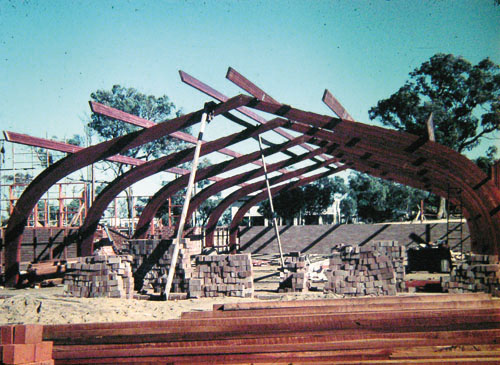
Designed by award-winning architect and Old Haleian, Tony Brand AM, the architecture of the dining hall is unique. The internal roof was designed to replicate the hull of a rowing boat. If you look up to the ceiling, the wooden beams are exposed, representing the inside of a rowing eight.
According to Tony Brand, supporting the roof was a challenge. They didn’t want to use wide columns as this would detract from the floor space. Tony wanted to use jarrah in line with the old jarrah boarding house tables that had been brought from Havelock Street. At that time Bunnings had plenty of small sections of jarrah and it was suggested these were used and laminated together to create large beams, which then became the beams in the roof today.
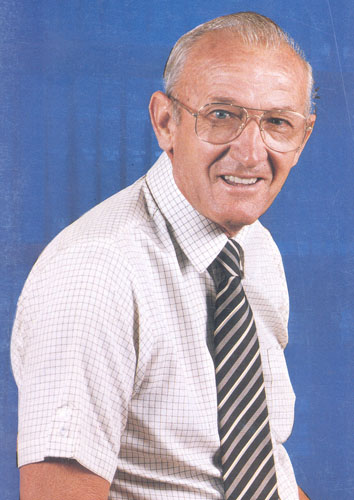
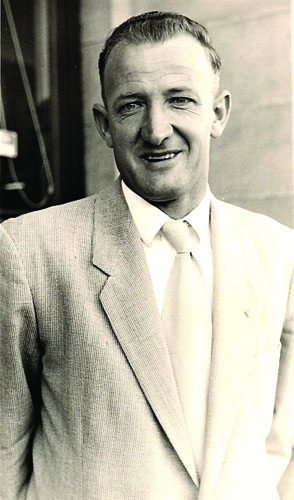
After the end of the Second World War, Kalgoorlie-born Flying Officer Tom Hoar faced the question of what to do next in civilian life. He chose teaching, completed a Diploma of Education, and in 1948 accepted what would become both his first and final posting—joining the staff of Hale School. He moved into School House on Havelock Street as an Assistant House Master and began his long career teaching Mathematics.
Tom quickly became known for his remarkable ability to make mathematics clear and accessible. His skill in the classroom earned him a reputation as one of Western Australia’s finest maths teachers, and within five years he was appointed Master-in-Charge of the Mathematics Department. He was well loved for his patience and willingness to help students, often giving up his lunch breaks and afternoons to support anyone struggling with their work.
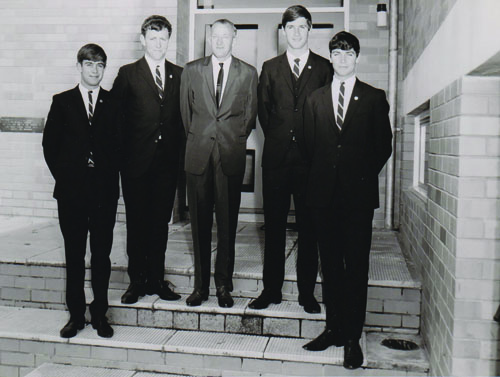
Beyond teaching, Tom contributed widely to school life. He served as Training Officer for the School’s Air Training Corps from 1950 to 1958 and as Officer-in-Charge from 1959 to 1962. He led Wilson House when it operated as a day house from 1954 to 1960, and when the School moved to Wembley Downs in 1961 he continued as Housemaster of the newly established Wilson boarding house. In 1966, with the opening of a new boarding house, Loton House, he became its Housemaster. The boarding community affectionately called it “Uncle Tom’s Cabin,” and even produced a quarterly magazine under the same name.
In 1971 Tom was appointed Deputy Headmaster under Headmaster Ken Tregonning. After retiring in 1985, following 37 years of service, he remained closely connected to Hale School. He worked as Secretary, Treasurer, and Committee Member of the Old Haleians’ Association until 1996, and later volunteered in the School Archives, continuing his commitment to preserving the School’s history.
Tom Hoar passed away on 30 April 2017 at the age of 92.
The long wooden benches still used today at each of the tables are from the original dining hall at School House, Havelock Street.
On the back wall is part of the shell of a Rowing 8 and an oar donated to the Archives by Old Haleians Bob Glover (1963-70), Kim Roberts (1966-69), Paul Malcolm (1968-73) and Frank Kuhn (1963-65).
On the inside east wall are hung framed AFL jerseys, each with an Indigenous design created by Year 12 students from each year from 2015.
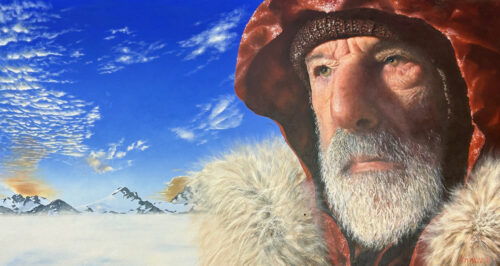
On the west wall of the canteen is a portrait of Old Haleian, the late Syd Kirby, explorer of Australian Antarctic Territory and the mind behind the phrase, Find your frontier.
This painting is of Old Haleian, Syd Kirkby (1944-50), painted by Tom MacBeth and entered in the Archibald Prize in 2010. It was jointly purchased by Hale School and the Fine Art@Hale Committee in 2010 when Syd officially opened that year’s Fine Art@Hale exhibition, in which his portrait was exhibited.
As a child, Syd suffered from crippling polio. With sheer determination and his family’s unwavering support, he overcame the disease and was able to attend school. After leaving Hale School, he trained as a surveyor and was subsequently selected, at the age of 21, for the 1956-57 Australian National Antarctic Research Expedition. It was to be the first of three winters he would spend on the icy continent.
In his first Antarctic expedition, he became the first man to venture into the Prince Charles Mountains with sleds and a team of huskies. It was here that he performed a series of astrofixes, which charted the coordinates of the Prince Charles Mountains.* Among his many other achievements in Antarctica were the establishment of the easternmost, westernmost, and southernmost astrofixes in Australian Antarctic Territory.
Syd Kirkby was awarded a Polar Medal in 1956. In 1966 he was made a Member of the Most Excellent Order of the British Empire (MBE) and in 2018, an Officer of the Order of Australia (AO) for distinguished service in surveying, polar exploration, research and mapping expeditions, and to professional scientific societies.
Syd was a proud and active Old Haleian, frequently returning to his alma mater to meet with staff and inspire students. He coined the phrase “Find your frontier,” which has since become a School tagline. While the world may offer fewer physical frontiers than those Syd explored, his message to the boys was clear: step beyond your comfort zone and discover the personal frontiers that shape who you become.
When asked about what he learned at Hale, Syd replied,
What did Hale teach me? … not just Geography or English, Physics or Maths, but the deeper things about commitment and endeavour, pride, honour and service. One’s duty was to honestly and sincerely try for worthiness, to put more in than one took out. I realised, too, that, succeed or fail, there was satisfaction and pride in the endeavour, and, with pride came the inclination to try more endeavours.
And every time, there was an increasing belief in one’s ability to succeed. And this, itself, generates success.’
Syd Kirkby AO, MBE died in Nambour, Queensland on 7 July 2024 aged 91.
*The original hand drawn map is in the School Archives and is available for viewing upon request.